
VTT N°04 - Causses and Valleys
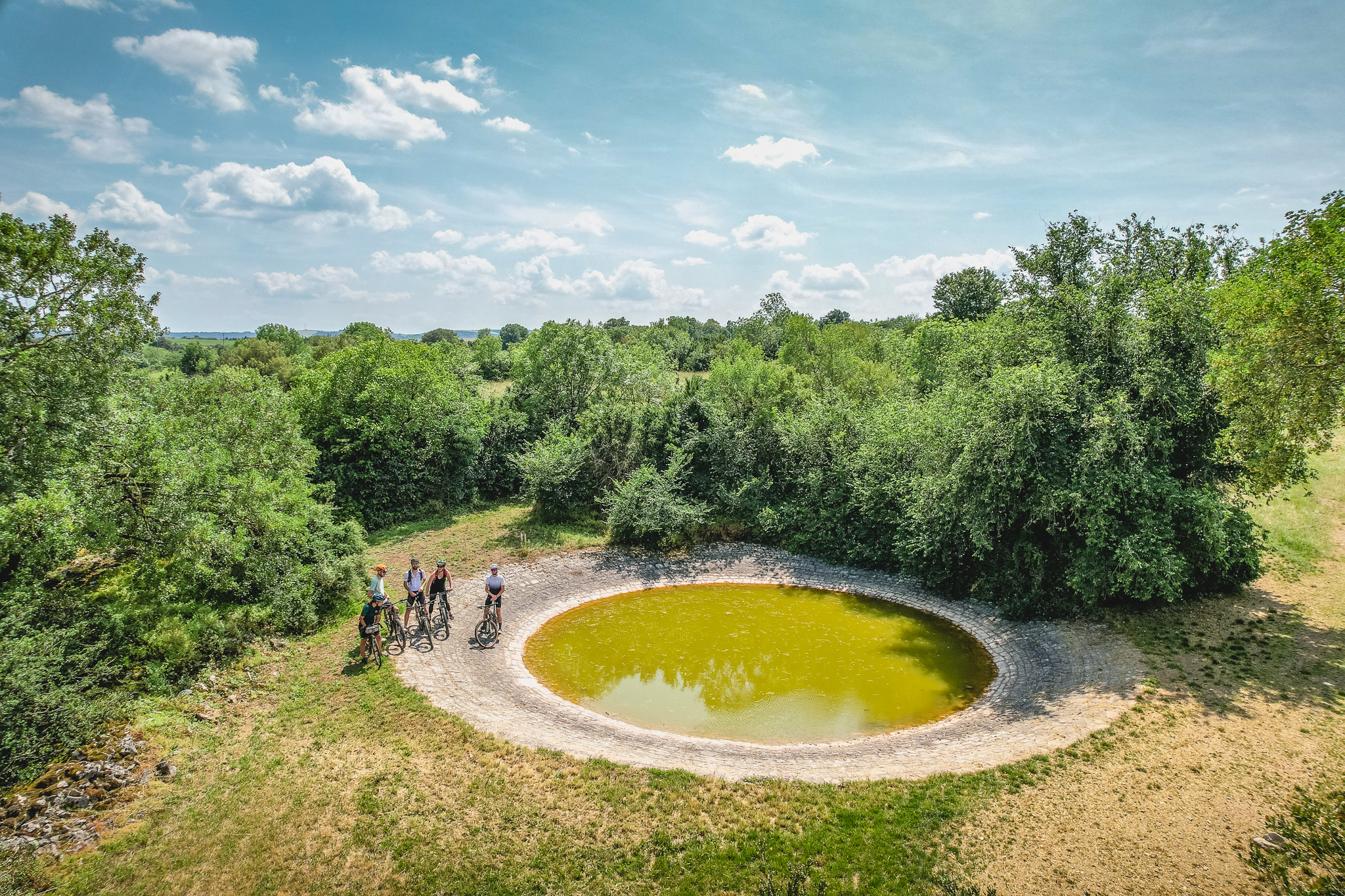
Along trails and singletracks, this fantastic journey across the Saint-Affrique area takes you through the Avant-Causses shaped by centuries of agropastoral traditions : lavognes, fortified farms and buissières. Superb views over Saint-Affrique, the foothills of the Larzac, the Verzolet Valley and the village of Versols add to the appeal of this remarkable route.
5 points of interest
Dolmen de Tiergues - David Potron  Dolmen
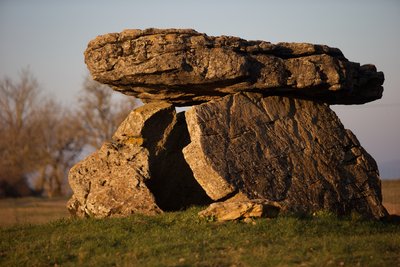
Tiergues dolmen
With nearly 1,000 dolmens, Aveyron is the French department with the highest number of these prehistoric monuments. Contrary to popular belief, they were not built by the Celts, but by Neolithic communities more than 4,500 years ago.
The word “dolmen,” meaning “stone table” in Breton, refers to prehistoric collective burial sites. Listed as a historic monument, the Tiergues dolmen is one of the most remarkable in Aveyron. Explored in the 20th century by archaeologist Émile Cartailhac, it bears witness to the beliefs and funeral practices of our distant ancestors. Nestled in a preserved natural setting, this site offers a true journey into the heart of prehistory.
Lavogne de Caussanuejouls - (c) DelphineAtche  History and heritage
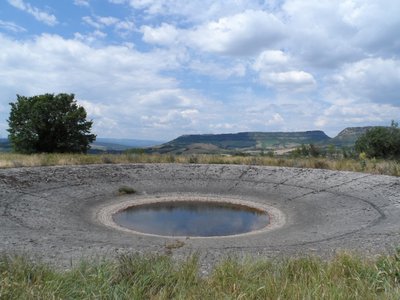
Caussaunejouls Lavogne
How a lavogne works is very easy to understand; imagine a gigantic upturned umbrella that collects rainwater!
In the beginning, there was a natural pond with impervious clay soil. This small pond was a real boon for people who quickly set these watering sources up as they were so critical on the causses where water seeps into the cracked limestone. First, they tiled the inside of the pond and finished off the work by laying paving stones around the edge of the pond to preserve the water quality and prevent gullying due to the large flocks trampling the soil when the sheep come to drink.
The pond tiling was made either with lauzes, flat stones or with paving stones laid one after the other.
Once completed, this gigantic upturned umbrella would provide a great variety of animals with a welcoming habitat, just look down over a lavogne and see how it swarms and buzzes with life; what a frenzy of activity!
From this lavogne, you will enjoy a stunning view to the north over the Combalou, a residual mound that shelters the Roquefort maturing caves.
Château de Versols - Xavier Waerzeggers History and heritageCastle and Fortification Remains
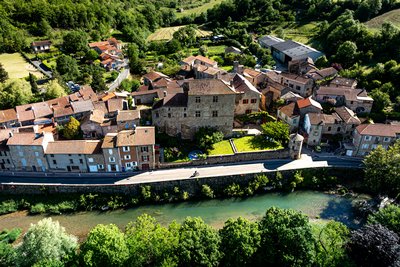
For nearly eight centuries, from 1250 to 1810, the castle was home to the Roquefeuil family. After leaving the family’s ownership, it passed through several hands, and part of the complex was converted into a farm. The estate was eventually repurchased by the Roquefeuil family in 1962.
The castle was part of a larger medieval castrum that enclosed the former village, perched on a spur between the Sorgues and Verzolet rivers. Originally a small fortress built in the 11th century, it was expanded during the 13th and 14th centuries to strengthen the site's defenses during periods of conflict, particularly the Hundred Years’ War.
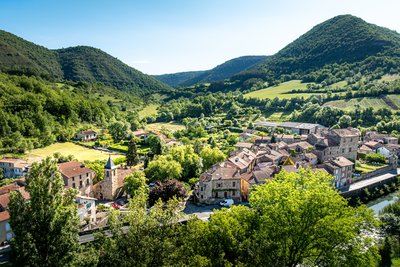
Village de Versols - Xavier Waerzeggers History and heritageVillage of Versols
The village of Versols has a rich history dating back to the Middle Ages. Its fortified settlement, built on a slight ridge at the junction of two valleys, succeeded an earlier Gallo-Roman site and once overlooked the major medieval route to Lodève.
Today, the village still preserves many traces of its defensive past, including a fortified gate, a tower, sections of ramparts, and elegant mullioned windows. Its main street and postern gate reflect the medieval layout of the settlement.
Versols is also home to the Church of Saint Thomas, while nearby stand the former Priory of Our Lady of Cayla and the Château de Montalègre, built in the 13th century.
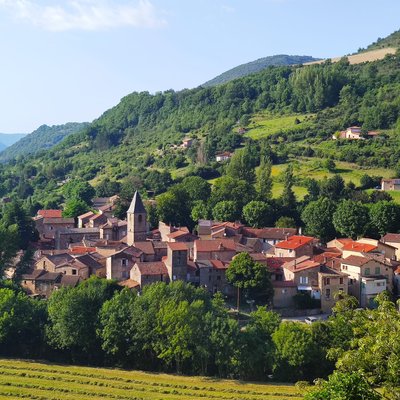
Village de Lapeyre - Roquefort Tourisme History and heritageVillage of Lapeyre
The name Lapeyre means “the stone” in Occitan, a reference to the rocky outcrop on which the village was built. Once part of the Knights Templar commandery in the 12th century, Lapeyre has preserved its medieval character, with narrow streets and old houses clustered around its tower.
Several historic features can still be seen in the village square, including mullioned windows, a medieval tower, and remains of a former convent. The current church, built in 1844, houses a remarkable Virgin and Child statue carved in Rome in 1860 from a single block of Carrara marble.
Lapeyre’s heritage is also closely linked to its textile industry. Established in the 17th century to process wool from the Causses, the former textile mill—still visible from the new bridge—stands as a reminder of an activity that shaped village life for centuries.
Description
(Recently modified route, trail signage updates currently underway)
The recommended starting point is on Rue du 12 Étoiles, at the mountain bike station. You can also start directly from Place François Fabié.
- Take the greenway towards Saint-Affrique, then follow the MTB signs until you reach the D50. Continue for 2.5 km to Moulin du Juge.
- Just before the small stone bridge, take the trail on your right.
- After climbing back up the valley, take the trail on your left towards the Tiergues dolmen. Once you have passed the dolmen, turn right onto the road to reach the village of Tiergues.
- Go through the village, then at the next junction turn left towards Canissac. At the D993, cross the road and continue to the Canissac farm.
- Go around the farm on the left. Join a wide track, then a beautiful buissière, crossing the plateau before plunging down towards Vailhauzy via a superb technical descent.
- In the village, 50 m after the church, take the small road on the left. After a fairly steep climb, continue onto the singletrack and descend towards the nightclub car park.
- Turn left onto the road, then take the first right after 50 m. You will find a superb singletrack on your left, running alongside the road’s retaining wall. Continue until you reach the greenway, then follow it uphill for 2 km.
- Just before a small bridge, take the trail on the right towards the Caussanuéjouls farm. A lavogne can be seen on your left via a 400 m round trip.
- Take the trail along the plateau towards Hermilix. Enjoy the views over the Verzolet Valley, which you reach after passing through the hamlet.
- At the bottom of the descent, turn right, then cross the bridge. Stay on the trail along the left bank to Versols.
- Follow the signs towards Lapeyre, then Saint-Affrique via the left bank of the Sorgues.
- Departure : Mountain Bike Station, rue du 12 Étoiles, Saint-Affrique
- Arrival : Mountain Bike Station, rue du 12 Étoiles, Saint-Affrique
- Towns crossed : Saint-Affrique, Roquefort-sur-Soulzon, Saint-Jean-d'Alcapiès, Saint-Jean-et-Saint-Paul, and Versols-et-Lapeyre
Forecast
Altimetric profile
Recommandations
Crossing of the D993 road.
Technical descent to Vailhauzy.
Bring a supply of water and suitable clothing.
Information desks

Saint-Affrique Tourist Office
Boulevard Aristide Briand, 12400 Saint-Affrique
OPENING TIMES:
The Tourism Office is open all year round, the opening hours are:
·July and august:
From Monday to Saturday: 9h – 13h & 15h – 19h
Sunday: 9h – 13h
·From September to June:
From Tuesday to Saturday: 9h – 13h & 14h – 17h
Closed: Sundays, Mondays and bank holidays
From November to April, the office is also closed on Saturday afternoon.
Transport
All the information is available on the Tourist Office website.
Access and parking
Saint-Affrique, 31 km south-west of Millau by the D992 and D999 roads.
Parking :
More information


Report a problem or an error
If you have found an error on this page or if you have noticed any problems during your hike, please report them to us here: