
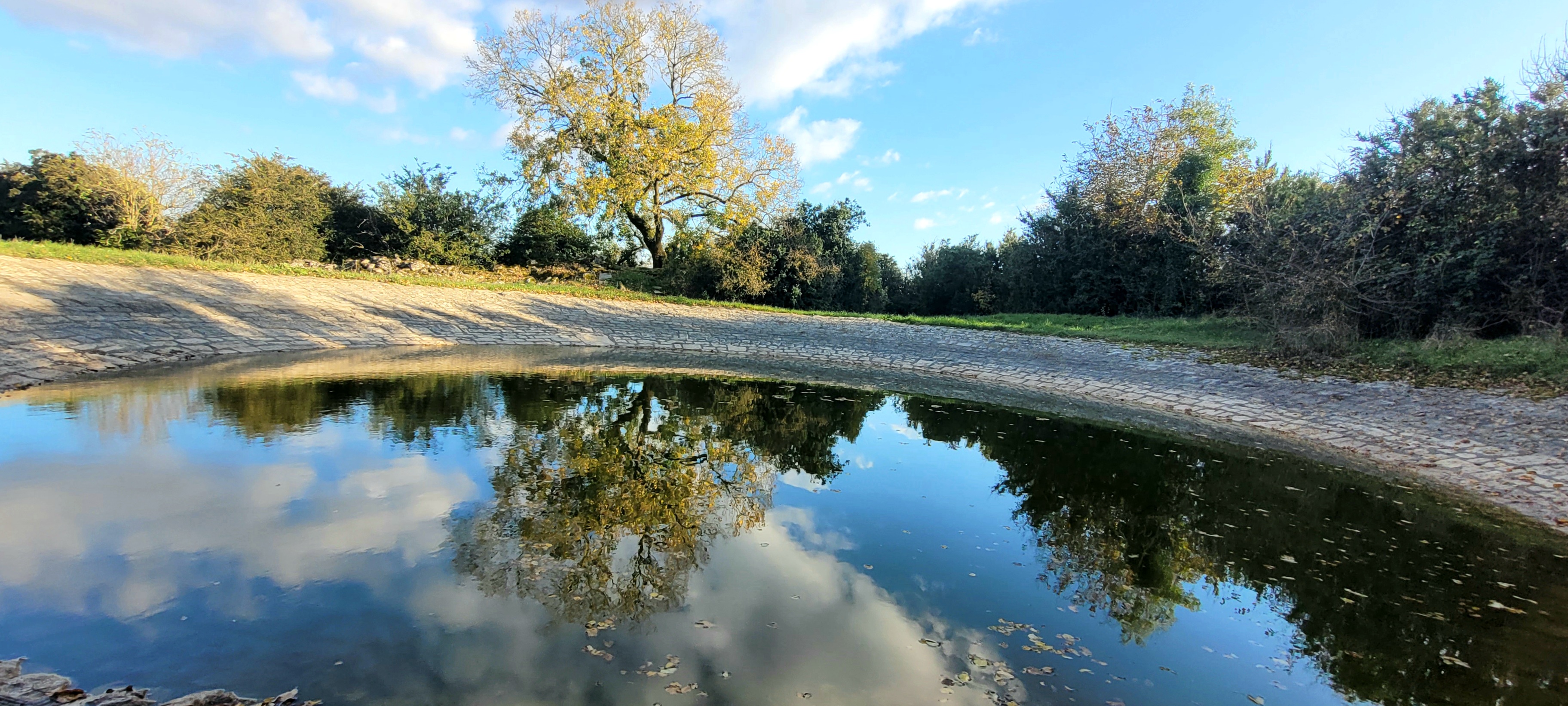
From the valley of Verzolet to the plateau of Hermelix
Explore the Verzolet valley and its stream which is a tributary to the Sorgues river, then walk uphill towards the Hermilix causse. There, as far as the eye can see, enjoy a landscape shaped by the agro-pastoral activity unfolding before you. The beautiful lavogne in Hermilix is worth seeing: a large pond with paved bottom and edge to water the sheep.
4 points of interest
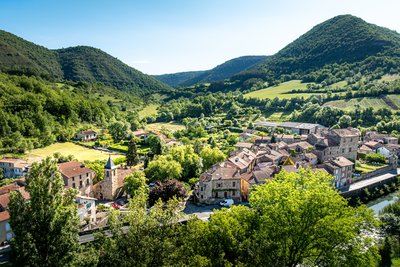
Village de Versols - Xavier Waerzeggers  History and heritage
Village of Versols
The village of Versols has a rich history dating back to the Middle Ages. Its fortified settlement, built on a slight ridge at the junction of two valleys, succeeded an earlier Gallo-Roman site and once overlooked the major medieval route to Lodève.
Today, the village still preserves many traces of its defensive past, including a fortified gate, a tower, sections of ramparts, and elegant mullioned windows. Its main street and postern gate reflect the medieval layout of the settlement.
Versols is also home to the Church of Saint Thomas, while nearby stand the former Priory of Our Lady of Cayla and the Château de Montalègre, built in the 13th century.
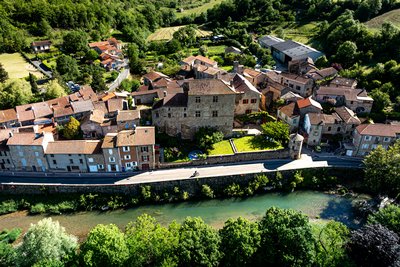
Château de Versols - Xavier Waerzeggers History and heritageCastle and Fortification Remains
For nearly eight centuries, from 1250 to 1810, the castle was home to the Roquefeuil family. After leaving the family’s ownership, it passed through several hands, and part of the complex was converted into a farm. The estate was eventually repurchased by the Roquefeuil family in 1962.
The castle was part of a larger medieval castrum that enclosed the former village, perched on a spur between the Sorgues and Verzolet rivers. Originally a small fortress built in the 11th century, it was expanded during the 13th and 14th centuries to strengthen the site's defenses during periods of conflict, particularly the Hundred Years’ War.
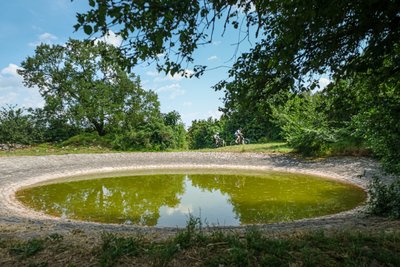
Lavogne d'Hermilix - Virginie Govignon  Agropastoralism
Hermilix Lavogne
Typical of the Causses region, lavognes are traditional water reservoirs designed to collect and retain rainwater in an area where water quickly disappears into the limestone bedrock. Built around a natural depression with an impermeable clay base, they were essential for providing drinking water to livestock.
To preserve water quality and prevent erosion caused by animals, the bottom and edges were carefully paved with stone slabs and flat stones.
Today, the Hermilix Lavogne is also a haven for a wide variety of wildlife, making it a small but thriving ecosystem.
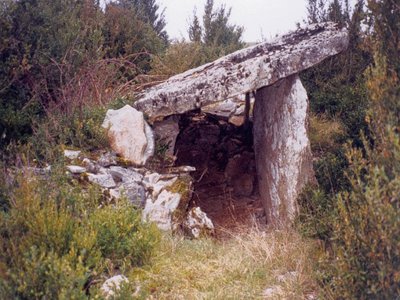
Dolmen d'Hermelix - PNR Grands Causses  Dolmen
Hermilix dolmen
Built nearly 5,000 years ago, dolmens are prehistoric funerary monuments erected by Neolithic communities. Originally covered by a mound of stones and earth, these burial chambers were used for successive interments over generations. They are particularly numerous on the Causses, where large limestone slabs were readily available for their construction.
This simple dolmen stands on a mound about 8 metres in diameter. Lacking a back slab, it still preserves its impressive capstone, which now leans slightly due to the gradual settling of one of its supporting stones over time.
Description
- From the church, follow the D7 towards Saint-Félix-de -Sorgues 50 m,take the first left and go past the bakery. After the porch, head to the right and then climb,let the fork to right and continue to climb over 250 m after the water resevoir.
- Take the left path towards Hermelix. Run along the fields on 800 m,down up to the Verzolet by the operating path,on a path that sinks the woods. After 1 km, cross a ravine and continue until a gateway.
- Shortly after the gateway, at the fork, follow the left path that climb to Hermelix.Bypass the village on the left and take still left,explotation path about 200 m.Getting to a branch indicating towards Versols, right. Access to the fountain: to head left (southwest) and return the farm road to the intersection indicating Versols.
- Take the path that runs between two rows of boxwood, pass before the lavogne and continue for 1 km. Take route du Causse Hermelix 50 m left, then go to the left to arrive to the farm Sayssou.
- 150 m before the buildings around the farm by the right.
- After 100 meters slightly uphill, around the bend,turn left into the path down to the ravine Sayssou.Pass before the cross Sayssou,continue the descent and lead on the explotation road.Continue, almost opposite, the path down the slope and joins Versols.
- Departure : Versols in front of the church
- Arrival : Versols
- Towns crossed : Versols-et-Lapeyre and Saint-Affrique
Forecast
Altimetric profile
Recommandations
Box tree moths are active from May to October. During the caterpillar phase, they feed on the leaves of box trees. They crawl down trees and move on long silken threads, although these threads are annoying when hiking they do not pose any health risk
Information desks

Saint-Affrique Tourist Office
Boulevard Aristide Briand, 12400 Saint-Affrique
OPENING TIMES:
The Tourism Office is open all year round, the opening hours are:
·July and august:
From Monday to Saturday: 9h – 13h & 15h – 19h
Sunday: 9h – 13h
·From September to June:
From Tuesday to Saturday: 9h – 13h & 14h – 17h
Closed: Sundays, Mondays and bank holidays
From November to April, the office is also closed on Saturday afternoon.
Transport
Travel by bus or train: http://www.mobimipy.fr/
Carpooling : BlaBlaCar, Rézo Pouce, Covoiturage-libre, Idvroom, LaRoueVerte, Roulez malin
Access and parking
Versols, 10 km south of Saint-Affrique by D 7
Parking :
More information

Source

Report a problem or an error
If you have found an error on this page or if you have noticed any problems during your hike, please report them to us here: